Atlas #7 · The island's towns
Firewood for Winter, in a Word the Plans Didn't Know
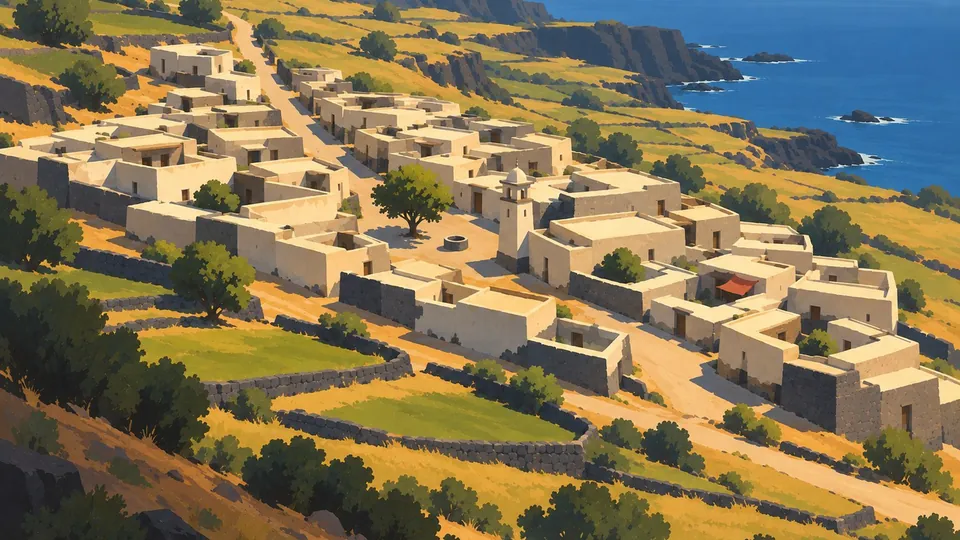
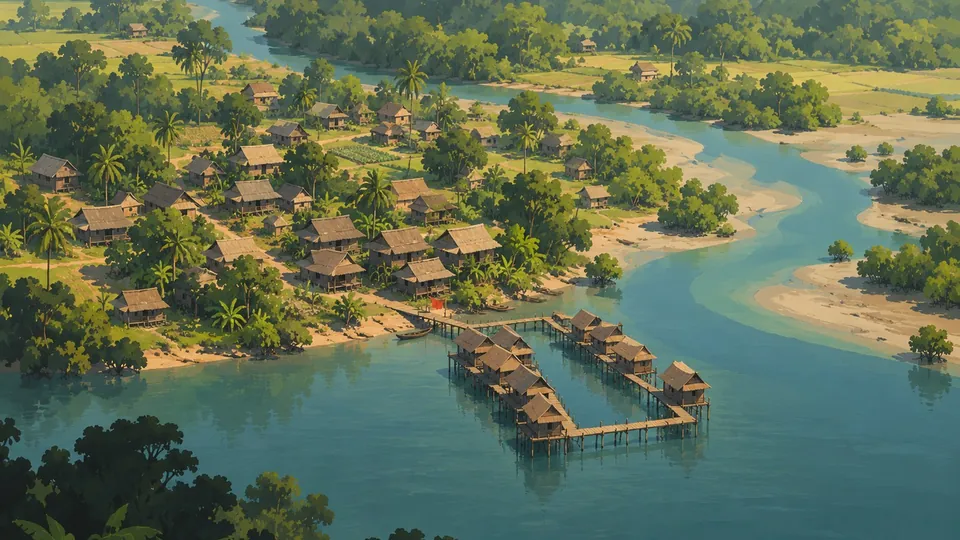
Concept art from the Atlas ontology: Snow collects behind the houses (concept 305)
In this post
At the edge of Lichtenloh, in the weeks its fields let its people go, a crew of three works a sawpit, and the woodpile beside it grows. Thirty-nine crews go out from the village, 1,705 from across the island, and in the southern desert 134 pairs of gatherers drive their donkeys out for brush. The wood is not for home. It is cut from what the woods have left over, for buyers the island's trade finds, and from the east much of it goes west by sea.
They come from 318 of the island's 900 settlements, a third of it: the north, the rain-forest east, the desert south. Until the morning of 19 October, no plan of any of them had a word for the crews. Without the word there would have been no plan at all.
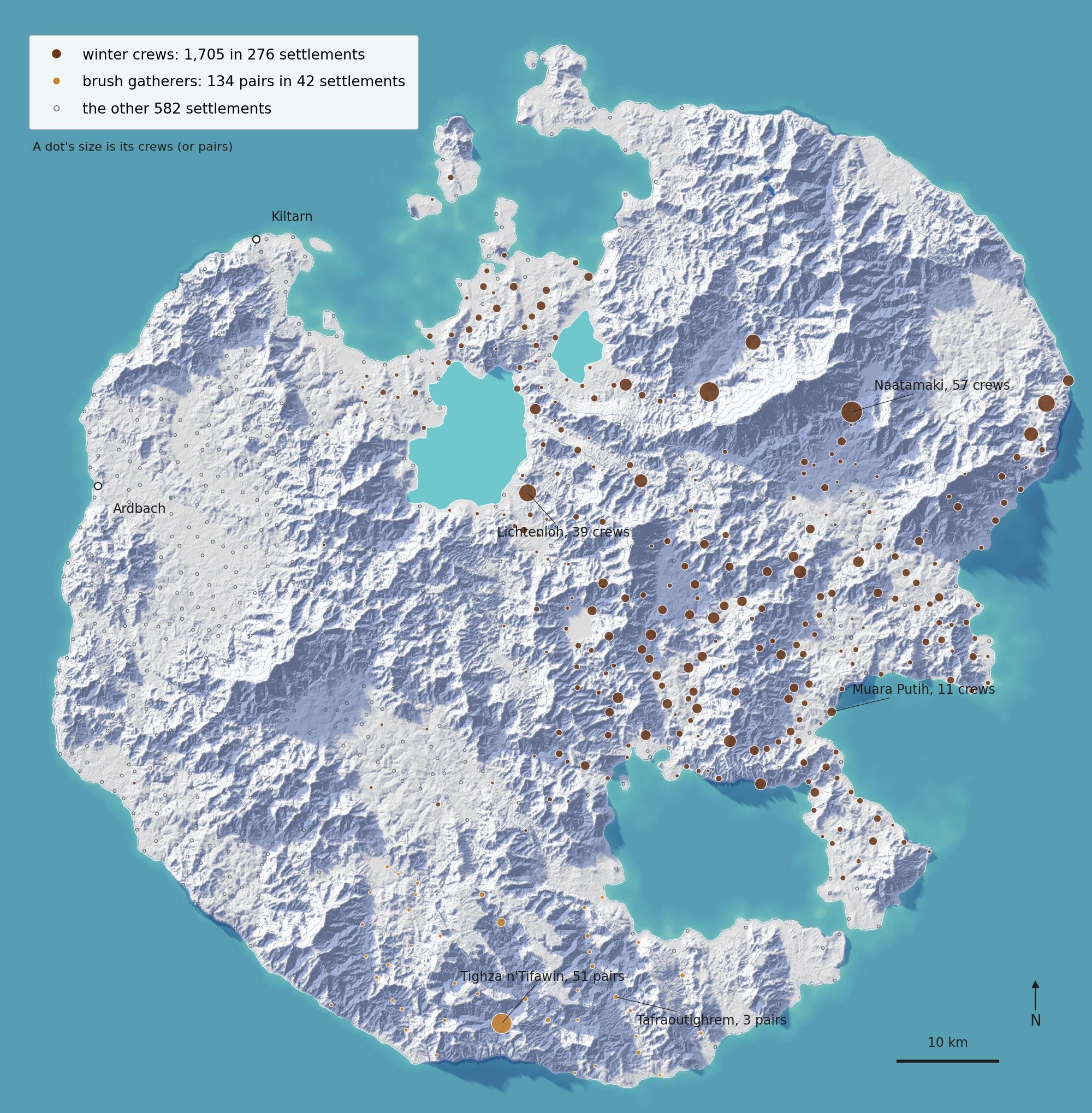
The 318 settlements on the island's paper relief (terrain aeead1e), from the economy's counts at trade run 15. Brown: the winter crews, 1,705 in 276 settlements, a dot's area by its crews. Ochre: the desert's brush gatherers, 134 pairs in 42. Grey rings: the other 582. West of a line 20 km west of the island's centre stand 335 settlements and 3 crews. Ardbach and Kiltarn, in white, keep none; their firewood comes by sea.
In the slack weeks at Lichtenloh#
Lichtenloh is a Germanic village of 649 people in 166 households, a nucleated village a little north of the island's middle. Each of its 39 crews is a farmer and two labourers: 117 people, near one in five of the village. There is never more than one crew for every three farm hands. They cut only in the woods left over once the village's own people are served, and only for buyers the island's trade finds them. A crew needs a woodpile and a sawpit by the village, not a camp in the forest.
It was not always so. In the counts of 16 October, Lichtenloh had 891 people and five woodcutters' camps, out in the 1,005 hectares of woods the counts asked for it: woodcutters by trade, living with their work. Two days later the island's land budget settled fewer people on the land, Lichtenloh among them. In the counts now it has 649, and no camps. It farms 16 hectares and buys its grain, and its 58 carters' yards carry the grain in and the firewood out. A village of woods and carts.
The two are not the same thing counted twice. A camp is three woodcutters and a carrier, out all year, and cuts about 930 tonnes of firewood a year if it cuts nothing else. A crew is a farmer and two labourers, out only in the slack weeks, and cuts 240 tonnes in a winter. One camp cuts about as much as four crews. Lichtenloh's 39 crews cut as much as some ten camps would.
The plan of 16 October found room for none of the five camps. A camp needs 150 hectares of woods of its own, and the plan reported "not enough land in the settlement's territory and terrain". The camps were counted, and stood nowhere.
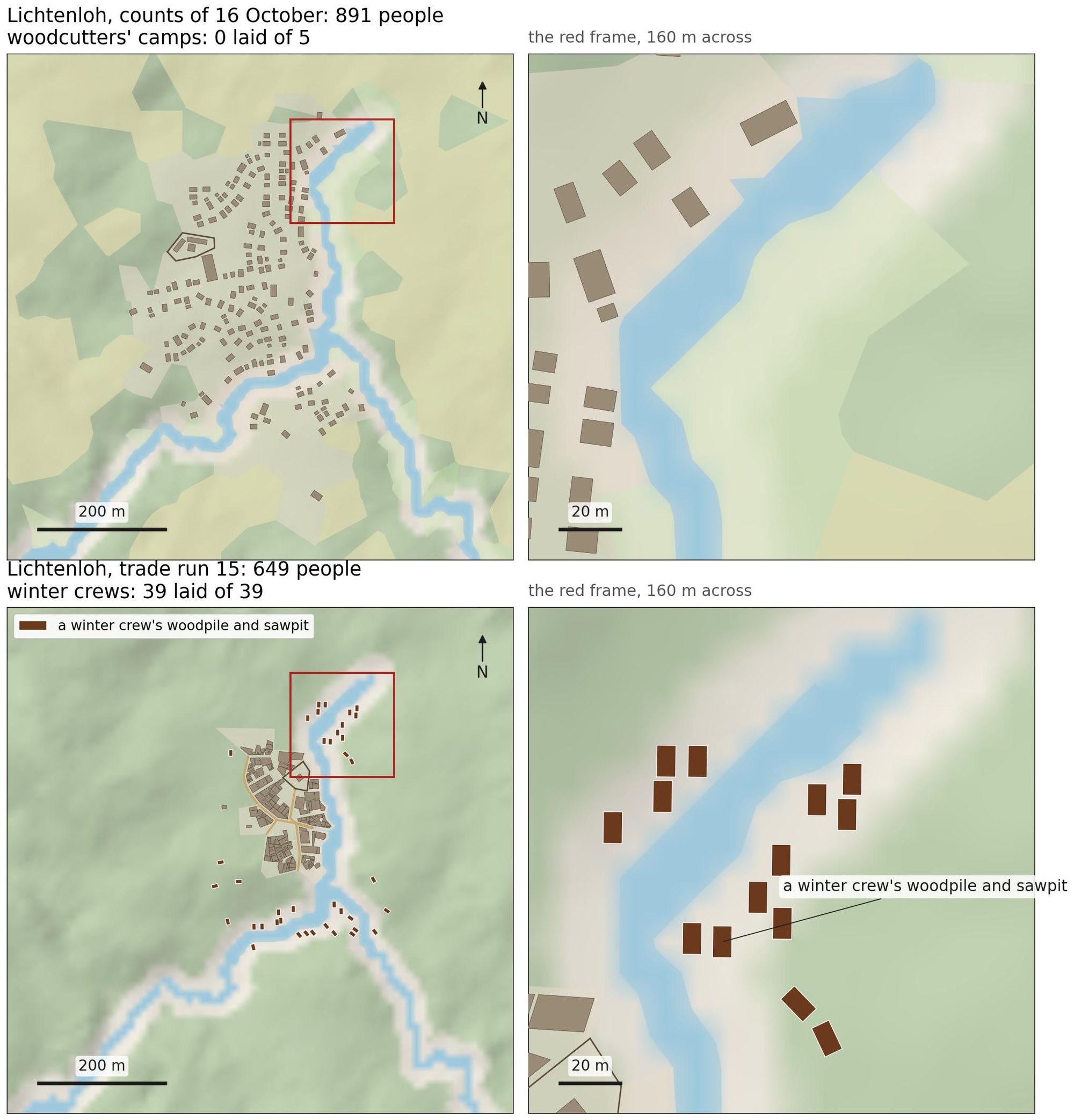
Lichtenloh, laid twice on the same terrain window by the same generator (dc8149a, roads mycelium v37): above, from the counts of 16 October; below, from trade run 15. Left, the area; right, the red frame, 160 m across. Brown: a winter crew's lot, 10 by 6 metres, for its woodpile and sawpit, 39 laid of 39. Above, the five camps were laid nowhere. The yellow fields went too: on the island's measured land, Lichtenloh's own territory, 452 hectares, holds 18 of plough, so it farms 16 and buys its grain. The lots are drawn as the plan lays them, plain; the woodpiles and sawpits in them are not drawn yet.
Fifty-seven crews from 155 households#
The most crews go out from Naatamaki, a Finnic-Baltic palisaded village in the north-east: 57 crews, 171 people.
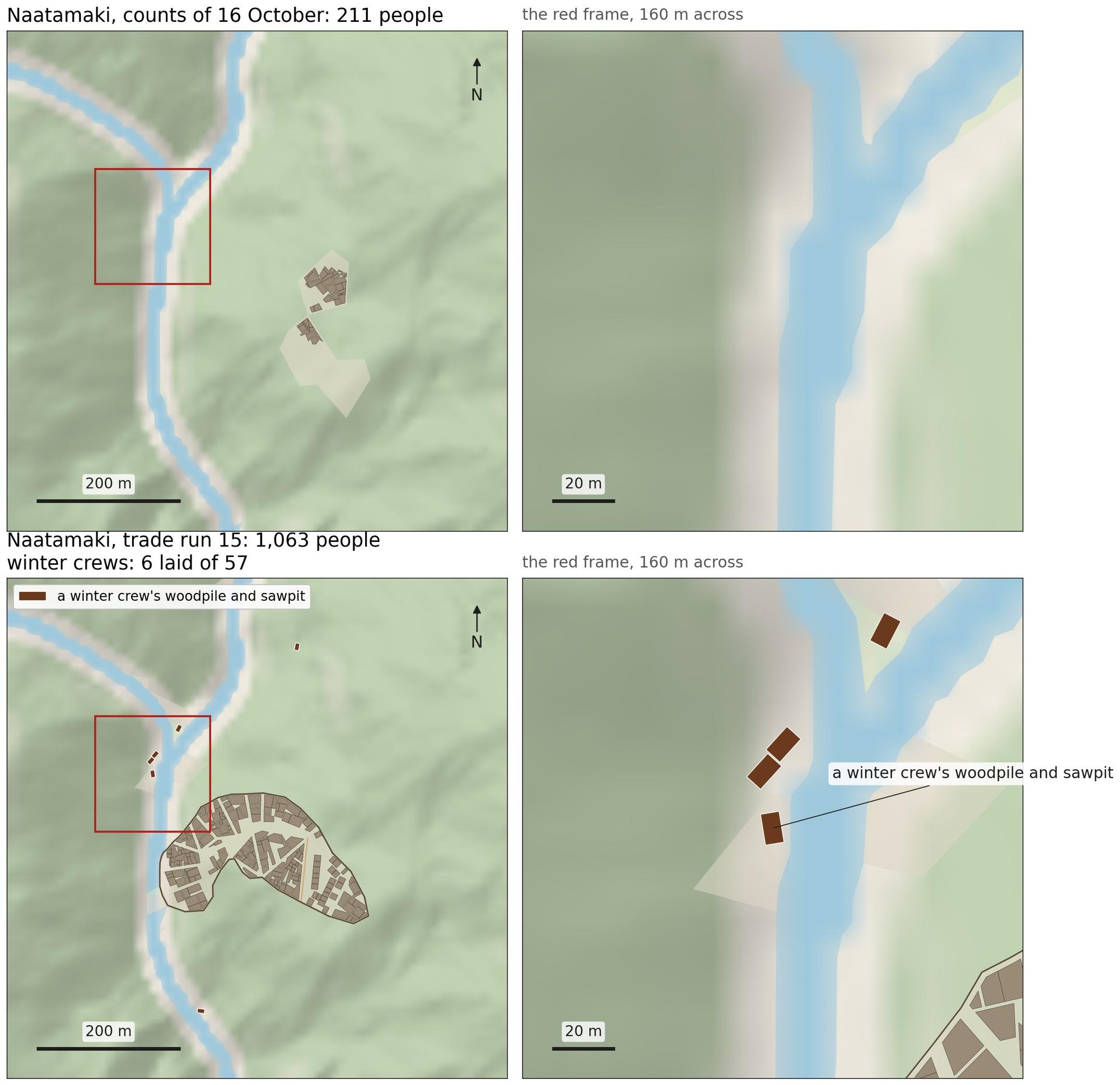
Naatamaki laid twice, as Lichtenloh above. From the counts of 16 October, 211 people; from trade run 15, 1,063. Its 6,264 hectares hold 878 of fields, far more than 211 people farm, and the land budget settles the hands to farm them. Of its 57 crews' lots the plan laid 6. For the other 51 it reports "no free ground round the town": the lots stand only at a town's edge, and this town's edge is full. The village has 155 households.
In the southern desert the fire is fed another way. The peasants and townsfolk burn brush: scrub, thorn, tamarisk and palm fronds, gathered on the wild land by two gatherers and their donkeys, for the towns. Tighza n'Tifawin, an Amazigh ksar of 1,320 people, keeps 51 pairs. In the counts of 16 October it had seven woodcutters' camps and a charcoal kiln.
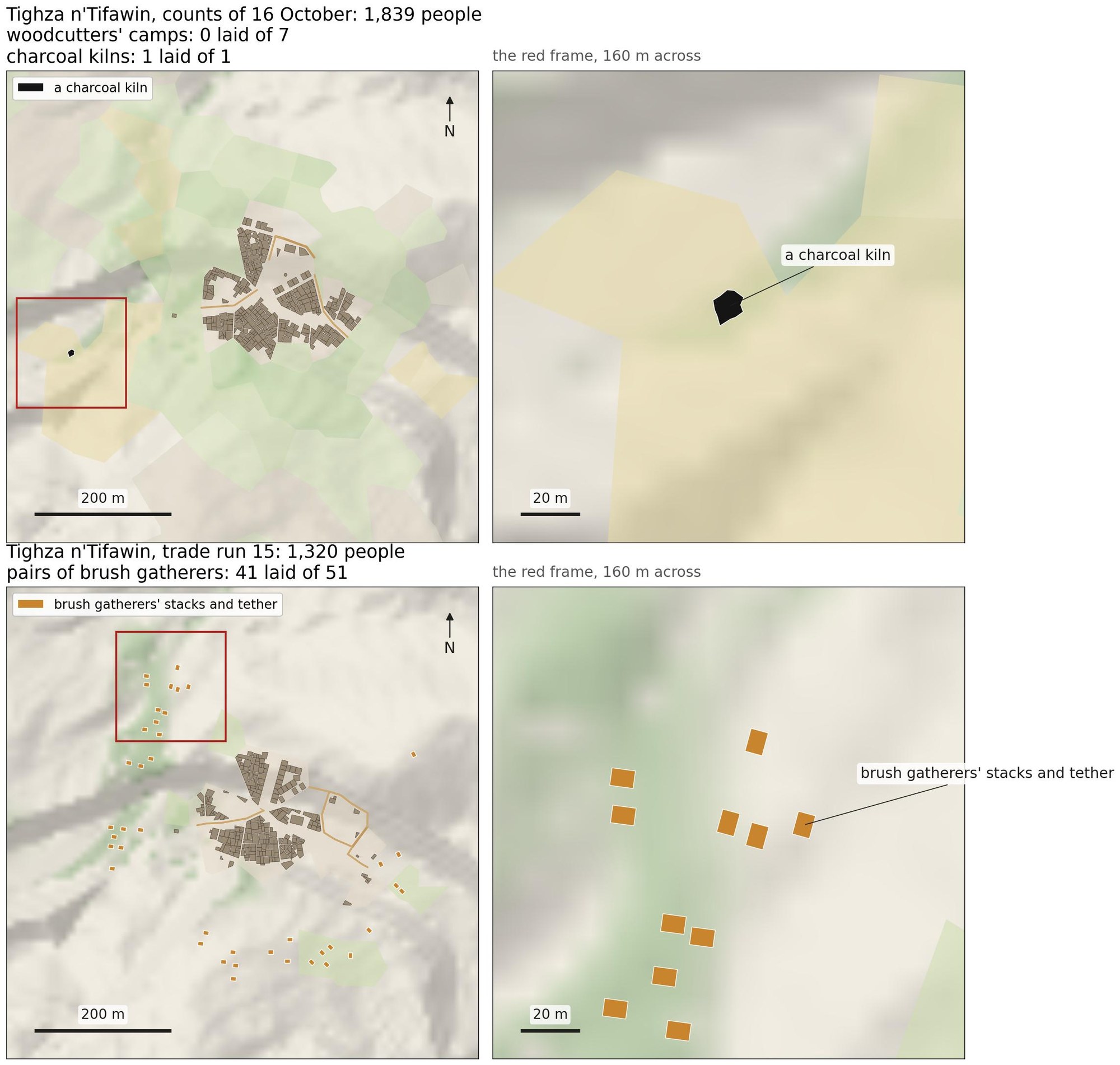
Tighza n'Tifawin laid twice, as above. From the counts of 16 October: 1,839 people, seven woodcutters' camps laid nowhere (no room, as at Lichtenloh) and a charcoal kiln, in black. From trade run 15: 1,320 people and 51 pairs of brush gatherers, 41 of their lots laid, 8 by 6 metres each, in ochre. For the other 10, "no free ground round the town".
Wood for the west#
The crews are thickest where the woods are fullest and the hands are many. Within a day's walk of the settlements more than 20 km east of the island's centre, 21,766 hectares of woods are left over after their own people; for those more than 5 km west of it, 4,135. The rain-forest east sends 515 crews from 75 Indonesian settlements, more than any other people.
The west, the 465 settlements more than 5 km west of the centre, has 13,523 hectares of woods within reach, and its own people use 11,015 of them. Little is left to cut for anyone else, so the west buys: from the middle of the island, from the east, and 14,788 tonnes a year from abroad.
Muara Putih is a stilt village of 93 people at a river mouth in the east. Every year 21,000 tonnes of firewood are loaded onto sailboats at its landing, most of it for Kiltarn and Ardbach, cities of 10,055 and 12,000 people some 72 to 75 km west. About 18,000 tonnes of it come down to the landing by pack train from villages inland, Tanah Sari alone some 10,400. The village's own 11 crews cut about 2,600 tonnes in a winter, a crew some 240, much of it for Karang Makmur.
The economy calls the season the winter weeks, everywhere. In the rain-forest east they are the slack between two rice harvests.
Two words the plans did not know#
Every settlement's plan is laid by the town generator from the economy's
counts. For each settlement the counts are a line of words and numbers.
Lichtenloh's ends winter_cutters: 39; Teluk Tinggi's has fishing: 20
and winter_cutters: 4. Each word names something the generator lays,
exactly as many as the number says. It knew 162 words. winter_cutters
was not one of them, nor was scrub_gatherers.
A word it does not know stops the plan. The whole settlement is refused, not just the word. That is on purpose. Every crew the economy lists is in its sums: the firewood they cut warms someone's house. A word skipped quietly would be 39 crews and nowhere to stack their wood, and no one would know. A refusal is loud, and it names the word.
Why did nobody hear it?#
The generator's tests and its example settlements all read its own copy of the counts. That copy was taken at 02:10 on 16 October. The brush gatherers came into the counts that evening, with the forest asks. The winter crews came at 00:22 on 18 October, with the land budget. On the old copy every line read cleanly, every test passed and every example was laid. The island's settled population had not yet been laid from the new counts.
The gap showed on the morning of 19 October, before the first lay on new counts: the water towns' houses over the water. The new counts' words, checked against the old copy's, held four new ones. Two the generator already knew. Two it did not.
What a refusal would have cost#
- 318 settlements of the island's 900, refused whole: 140,695 of the 480,809 people the counts settle.
- Three of the seven water towns. Teluk Tinggi, Telaga Baru and Wassermark were to be laid that night with their households over the water. Each also sends winter crews.
- The next step. Laying the whole island's settled population would have failed at every such line.
Nothing published was touched. Every example settlement pinned so far was laid from the old copy, and still is: they show the island as it was before the land budget.
A woodpile, a sawpit, a tether#
Since commit dc8149a (19 October) both words are the generator's. Each
winter crew gets a lot of 10 by 6 metres at the village's edge, for its
woodpile and its sawpit. Each pair of brush gatherers gets 8 by 6 metres,
for their stacks of brush and their donkeys' tether. In the world's
vocabulary they are a
woodcutters' camp
and a harvest camp.
The economy's next counts, trade run 16, bring words of their own: the
wayfarers' rounds (pedlars, tinkers, minstrels, pilgrims and beggars, who
sleep in inns, almshouses and barns and keep no building) and the hectares
each village's holdings farm. Those are read already, before they arrive.
One more word could come in any run: bargemen, a river barge and its two
boatmen at a landing. No line carries it yet, and the plans cannot read it
yet either.
What runs, and what does not yet#
- Runs, in the economy: the winter crews since the land budget of 18 October, the brush gatherers since the forest asks of 16 October.
- Laid, in the plans: since
dc8149a(19 October), a lot for every crew and every pair, at the town's edge. Lichtenloh has all 39; Tighza n'Tifawin 41 of 51; Naatamaki 6 of 57. Where the edge is full the plan lays the rest nowhere and says so. Letting the lots stand further out is the next step, not yet made. The generator's full test suite passed on that commit on 19 October (06:59 to 08:05: formatting, lints and all 35 test suites, with tests for both words); it is on the generator's main. - Not yet drawn: the lots are plain lots on the plan. The woodpiles, sawpits, brush stacks and tethers in them are not drawn yet.
- Not yet laid: turf. Where the woods within a day's walk cannot give the households' firewood, they burn peat, dung cakes and straw. The counts carry no word for it, and the plans show none yet.
- Not in the game: the game does not lay the island's towns yet. These are the generator's plans.
Between two rice harvests, eleven crews go out from Muara Putih's houses on their piles. Pack trains come down from the villages inland. At the landing the sailboats load, and leave westward.