Atlas #3
Who Built the Rainbow Gate?
In this post
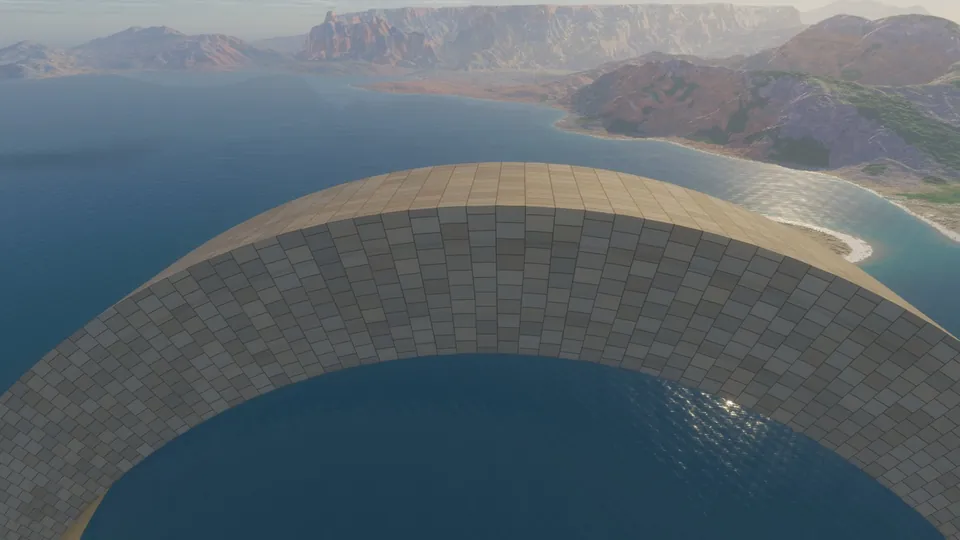
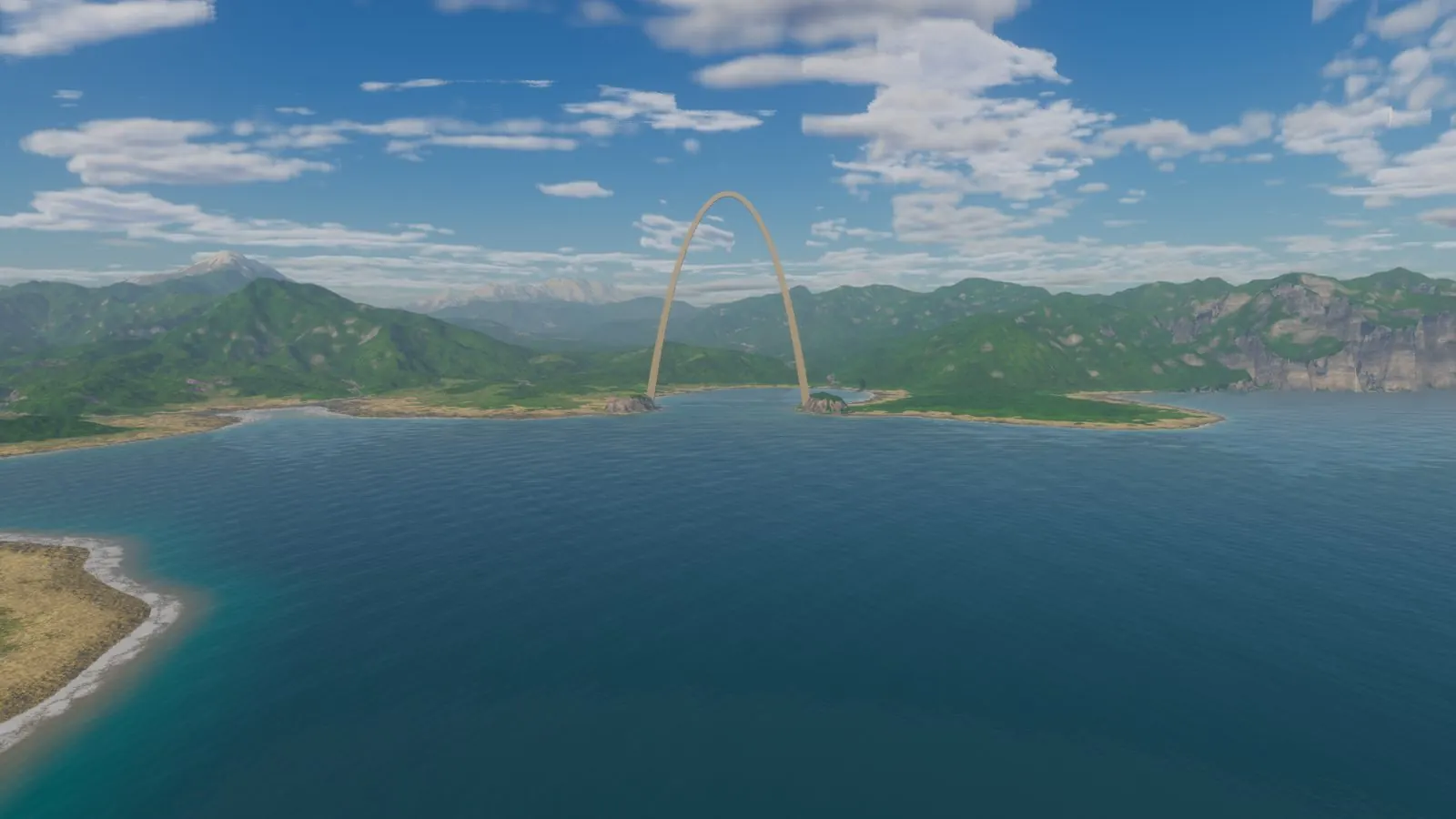
The Rainbow Gate is a stone arch 1,165 metres high over the mouth of a cove at the head of our island's great southern bay. Every stone of it can be measured. Who raised it, no one on the island can say.
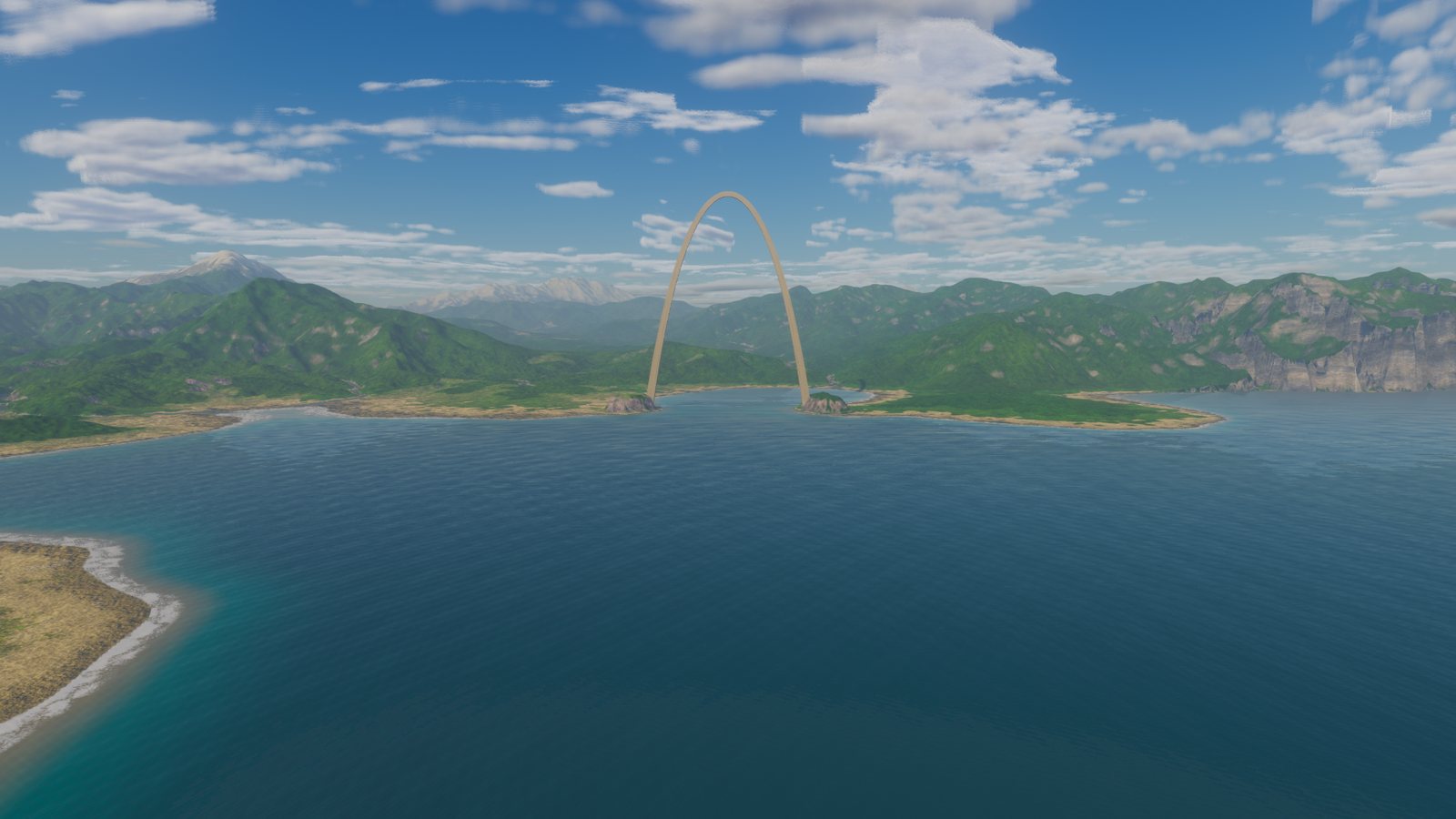
The Rainbow Gate from the bay, looking north-east into the cove. Engine render at Atlas c65fcf7, 2026-10-17 (render.rainbow-gate-bay).
Its feet#
Its feet stand 895.5 m apart, one on each of the two headlands that close the cove. Each leg is a column of dressed blocks, ten across at the foot, and it goes on 30 m down into the rock.
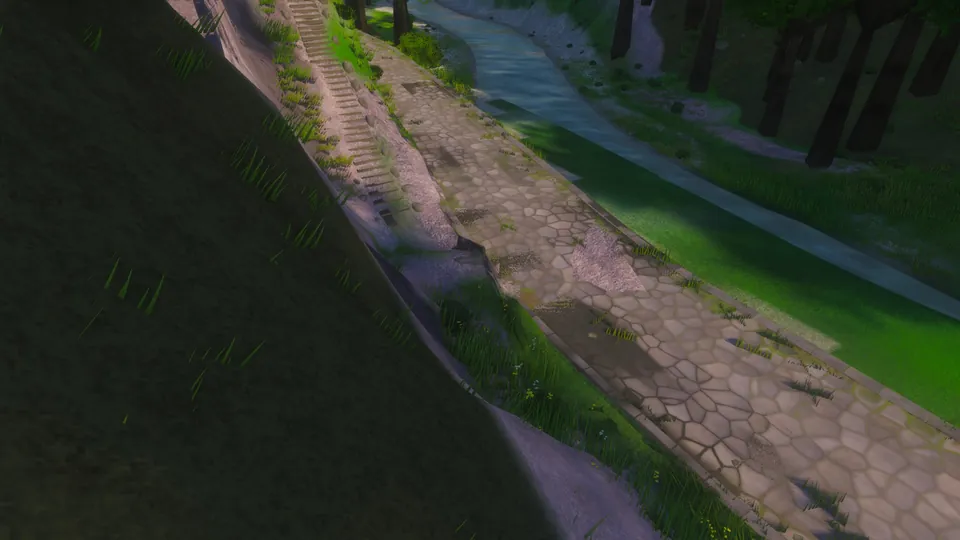
Where a leg meets the rock it covers 2,005 m². So far the town generator has laid 19,460 buildings in 59 of the island's towns. The largest of them, the church at Damebois, covers 1,984 m².
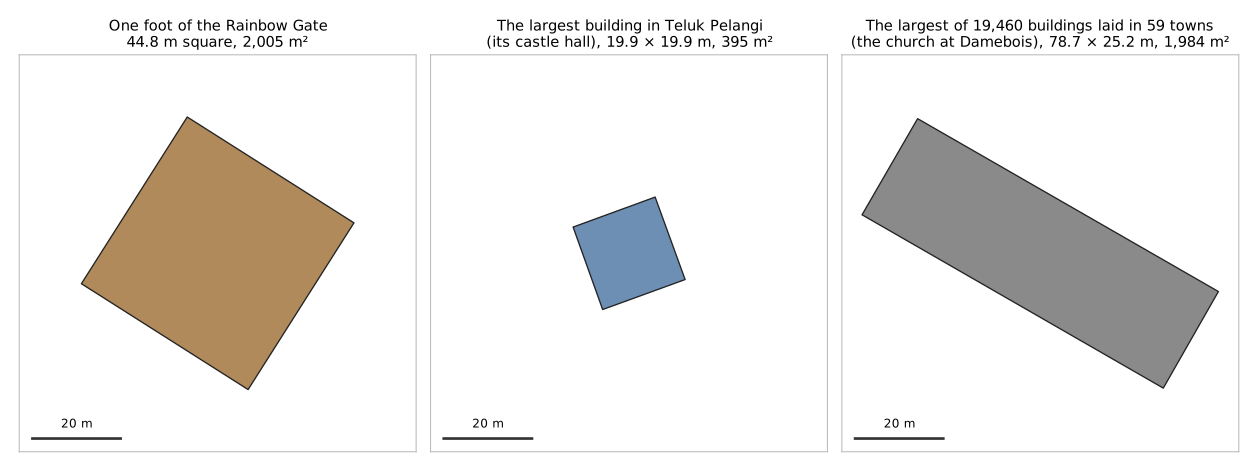
To one scale, north up: one foot of the Gate, the largest building in the city at its feet, and the largest building laid anywhere on the island. The outlines are from the world query database.
The Bay of the Rainbow#
Behind the arch lies a city of 12,788 people. Its harbour is inside the Gate: the way in from the sea runs between the Gate's feet.
The city is called Teluk Pelangi. In the coast's language that is the Bay of the Rainbow. It is where the river survey's thick red line ends: a river of cargo where no boat could go.
The Shard, the Arches, the Giants#
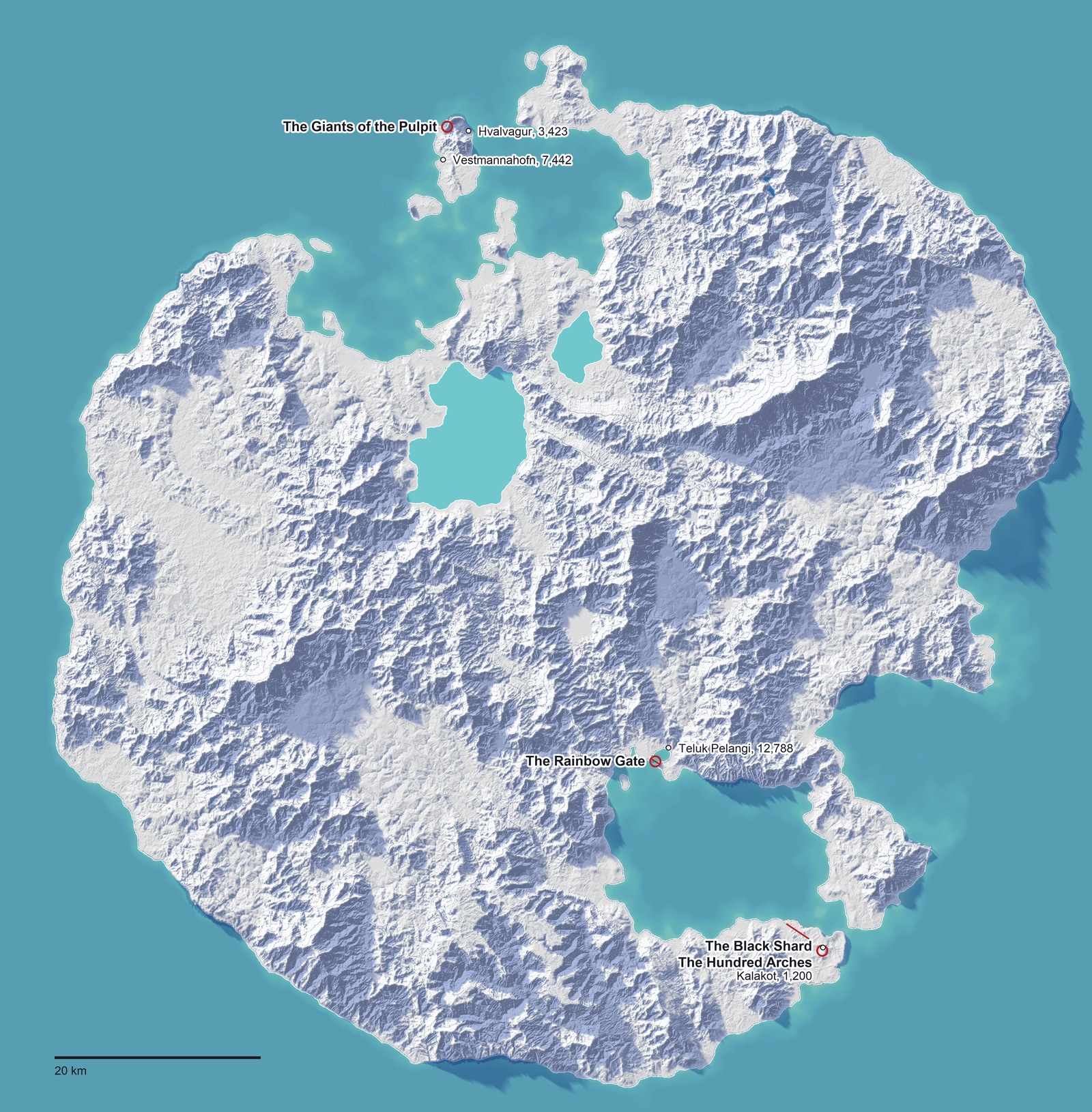
The island on its paper relief, with the four monuments in red and the towns at their feet in white.
The island has four works of this size. The ontology files each one as a
place (poi.artefact.*), with its classes, its realm, and the code that
builds it.
The Black Shard is a slab of black stone on the Lava Tip, the island's south-eastern end, 300 m wide and 100 m thick. Its top is cut on a slant, 1,000 m high at one edge and 900 m at the other. Lava runs out of its top and down its faces. A village of 1,200 people stands 313 m from its middle: Kalakot, Black Fort.
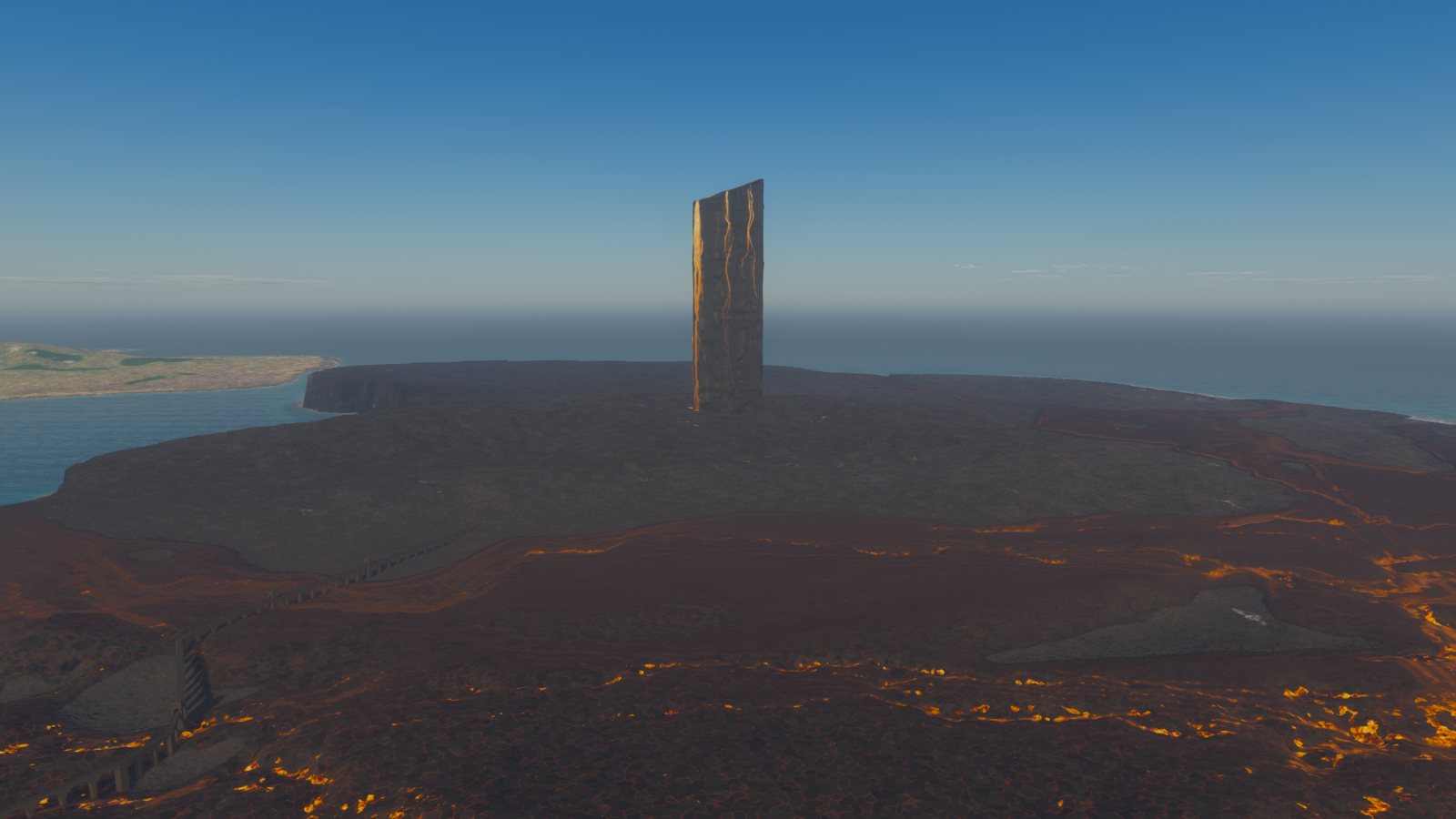
The Black Shard from the crater's side. Engine render at Atlas c65fcf7, 2026-10-17 (render.black-shard-front). There are no houses at its foot yet. The town generator has laid 59 of the island's 900 settlements so far, and Kalakot is not one of them.
The Hundred Arches is a bridge 2.8 km long across the lava field north-west of the Shard. It runs in fifteen straight legs that turn on rock islands. It has exactly a hundred arches: 24 in its longest leg, one in its shortest. Nine towers stand along it.
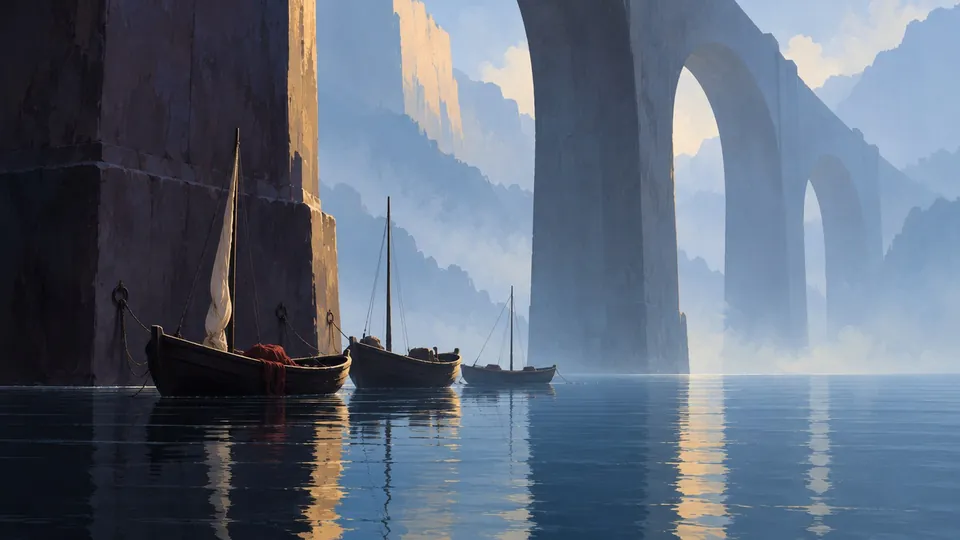
The Giants of the Pulpit are three hooded figures with folded arms, each in its own niche. They are cut into a slate wall, 480 m high at its highest, on an islet in the north. The rock's layers run straight through the figures and their niches: they were cut out of the cliff, not set against it.
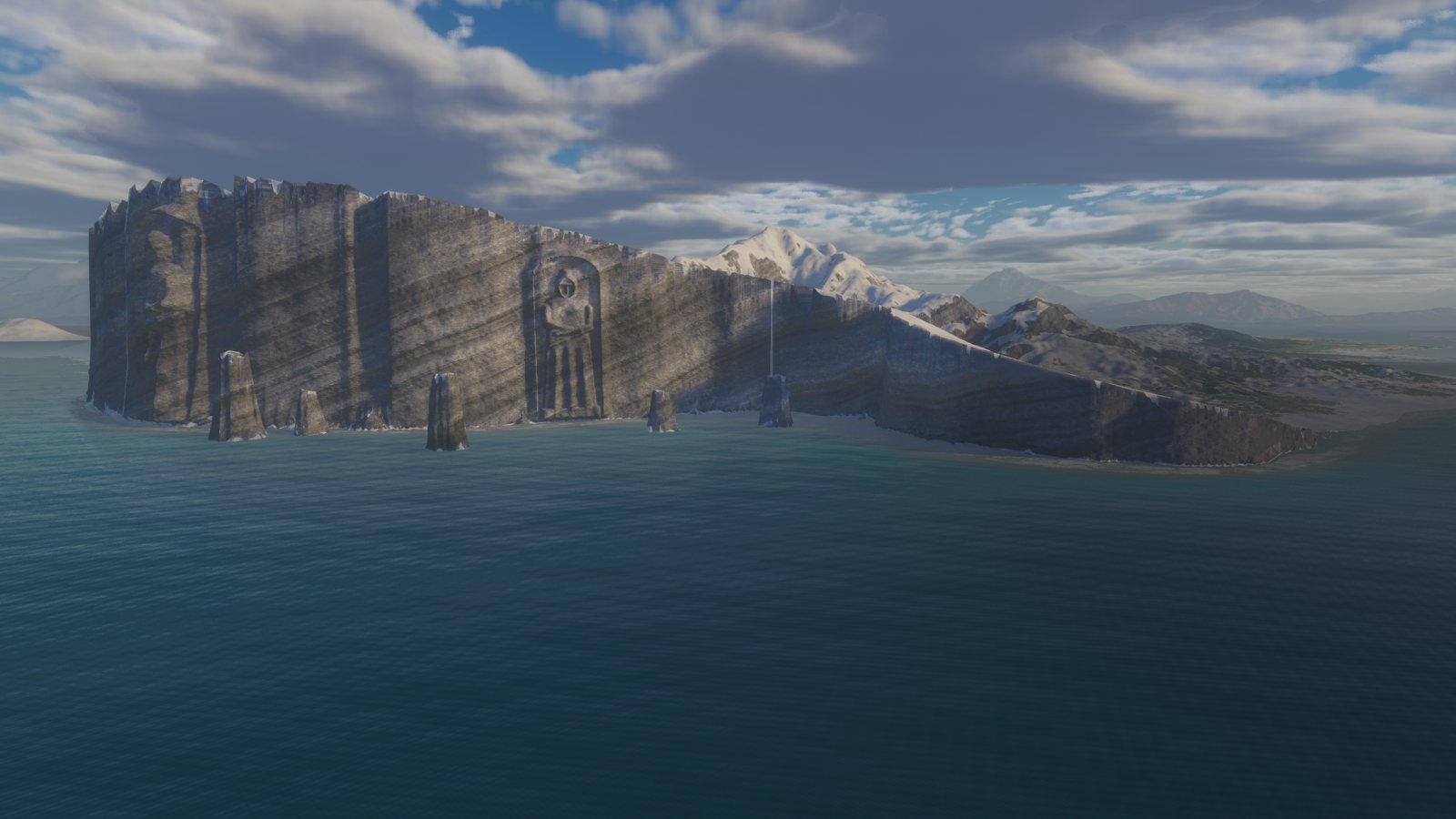
The Giants of the Pulpit from the sea. Engine render at Atlas c65fcf7, 2026-10-17 (render.cliffs-12-giants). Two of the three are in view.
The nearest towns are Hvalvagur, 3,423 people, 2.1 km away, and Vestmannahofn, 7,442 people, 3.2 km to the south. Vestmannahofn is the westmen's harbour.
Thirty-eight sightings#
The ontology's proposal register lists 38 approved concepts of things like these: - a hand in a lake whose fingers are moorings; - a bell fallen into a village and used as a market; - rooms behind a carved face; - a stone disc whose shadow covers a well.
None of the 38 is one of the four, and no approved concept shows any of the four. In the ontology the 38 wait under a proposed class, with no place on the map.
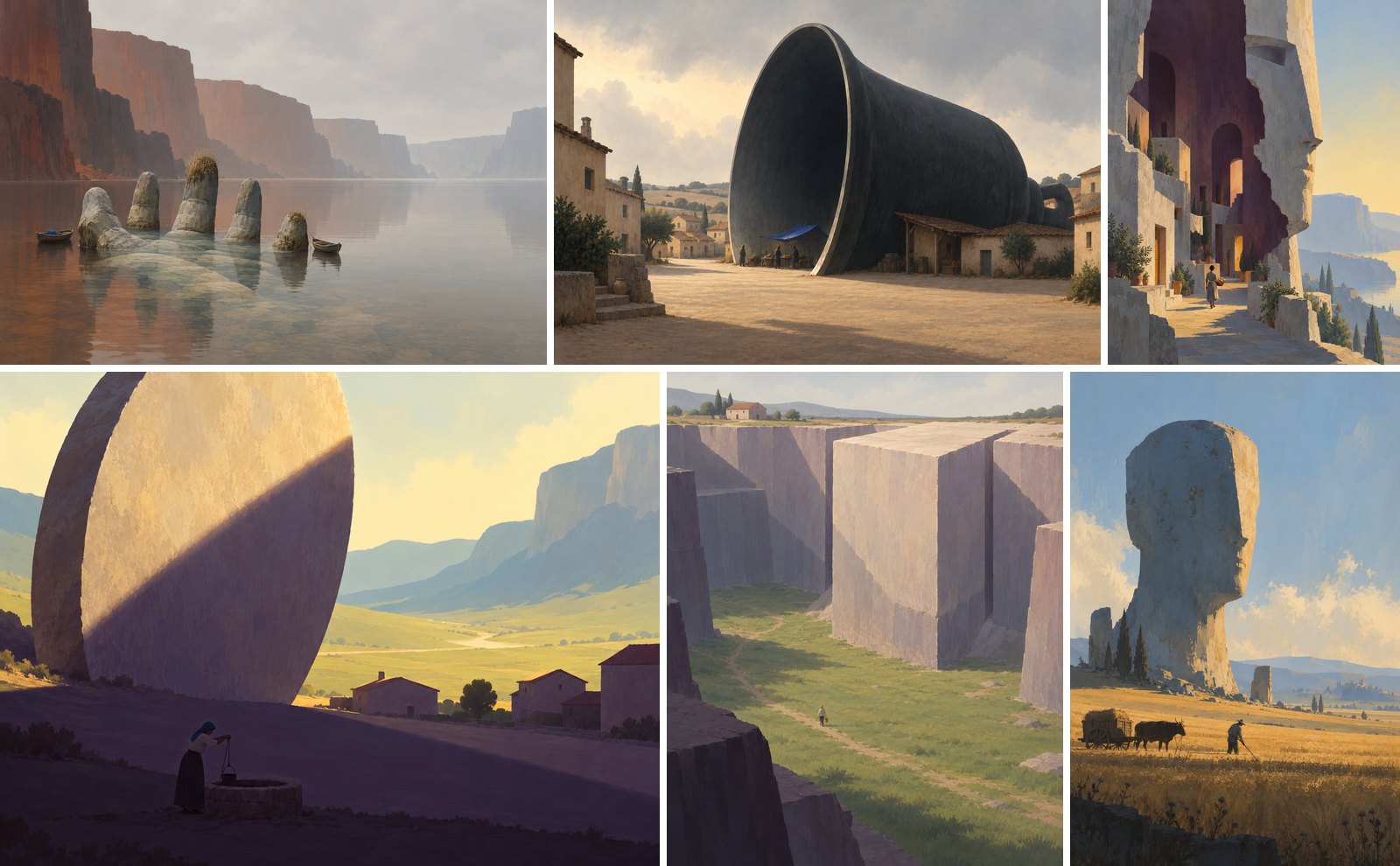
Six of the 38 approved concepts, in rows from top left: Five moorings, Fallen bell market, The rooms behind the face, Water in the disc's shadow, The stone they never lifted, Abstract head in the wheat field.
What the ontology keeps#
The ontology deals in facts: classes, places, numbers, and the code that
builds each one. Its class for the Gate, fantastic.form.colossal-arch,
says that people made it: "a human-made arch of dressed stone". Which
people, it does not say. For the monuments we have proposed three kinds of
statement, kept apart on every page (specs/ontology-mystery.md in the
Atlas repository):
- Measured is what the world holds. Every number in this post is measured, and each one comes from a file named in this post's sources.
- Held is what the island's people do with these things and call them. The Bay of the Rainbow and Black Fort are held. Later come their tellings: myths, each attributed to a people and marked as told, never as what happened.
- Withheld is one line, the maker. It stays blank, and a check fails any page that fills it in.
The team decides the proposal. None of it is on the ontology site yet.
The blank is not a teaser. The team said it plainly today: who left these enormous things around the island is a true mystery of the world. Nobody working on Atlas knows the answer, so there is no answer to reveal later. The numbers around the blank stay exact: the mystery is in the world, not in what we say about it. Where we looked for a pattern and found none, the proposal says so. The Gate lies 7.1 km off the line from the Shard to the Giants.
Six people live at Lambagjogv, 333 m up on the Giants' slate, two and a half kilometres from them.